
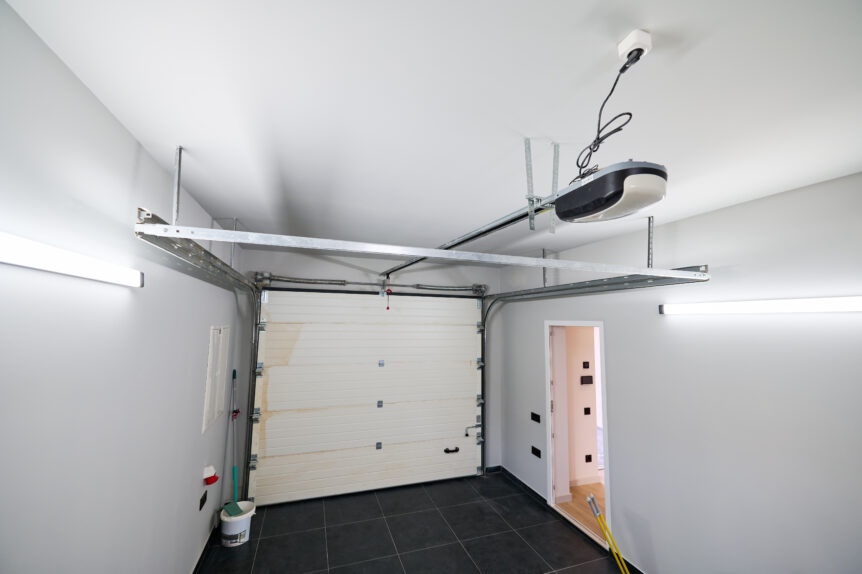
Your garage door opener runs a few times a day, every day, and like any motor it wears out after years of daily use. Most people don’t think about it until they find their garage door opener not working right. Maybe it’s louder than it used to be, or the door stops halfway and backs up for no reason. Sometimes a quick repair fixes it. Other times a garage door opener replacement is the smarter move, and putting it off just means paying for repairs on a worn out opener that’s on its way out.
Here at Dimitroff Door Repair, we put together 8 common reasons homeowners in Dumas and across the Texas Panhandle end up needing a new opener, how to tell whether the problem is really the opener or the door, and how to decide whether to repair or replace.
How Long Do Garage Door Openers Last?
Most garage door openers last about 10 to 15 years. Where your garage door opener lifespan falls in that range depends on how often the door gets used, how well the door is balanced and whether anyone has ever done basic maintenance on it.
A household that runs the door 6 or 8 times a day puts a lot more open and close cycles on the motor and gears than a retired couple who opens it twice. If the door is heavy or out of balance, the opener works harder on every trip, and that shortens its life too.
Panhandle heat and cold play a part as well. Summer heat in a closed garage, winter cold snaps that stiffen the grease, and the dust that wind blows in under the door all add wear to the motor, gears and the moving parts on the rail. None of that kills an opener overnight, but it’s one reason some openers around here are worn out closer to the 10 year mark than the 15.
8 Common Reasons Your Garage Door Opener Needs Replacing
Some of these signs mean your opener is close to done. Others mean it still works but is missing safety or security features that every opener should have today.
1. It’s 10 to 15 Years Old (or Older)
If you’re wondering when to replace a garage door opener, age alone is a good place to start. An older opener lacks the safety and security features that come standard now. Parts availability is the other issue: once a model has been discontinued for a while, parts for it get harder to find and cost more when you do find them.
If your opener is in that 10 to 15 year range and starts having problems, it usually makes more sense to put the money toward a new unit than to keep fixing the old one. Look for a manufacture date on the label on the motor housing if you’re not sure how old it is.
2. It’s Loud, Grinding or Shaking
Every opener makes some noise, especially a chain drive opener, which runs louder than a belt drive. When a garage door opener is making noise, what you’re listening for is a change. A new grinding noise, a loud clunk at the start or end of travel, or a rail that shakes and rattles while the door moves are all signs something inside is wearing out.
Grinding usually points to a worn drive gear or a motor that’s starting to fail. A loose rail or chain can sometimes be tightened, but if the noise is coming from inside the motor housing on an older unit, a garage door opener replacement is often the better fix.
3. The Door Stops, Reverses or Won’t Close All the Way
This is the most common version of a garage door opener not working. When the door reverses on its own, stops partway or won’t close all the way, the first things to check are the safety sensors and the travel settings. The logic board inside the opener controls how far the door travels (the limit settings) and how hard it pushes before it backs off (the force settings).
On a newer opener, adjusting those settings or cleaning the sensors usually fixes it. On an older opener, a worn circuit board can cause random stops and reversals that keep coming back no matter how many times the settings get adjusted. That’s a sign the electronics are failing, and a new logic board on an old unit is rarely worth the money.
4. It Doesn’t Have Safety Sensors
Look at the bottom of your door tracks, no more than 6 inches off the floor. You should see two small garage door opener safety sensors (photo eyes), one on each side, facing each other. If they’re not there, your opener is almost certainly a pre-1993 unit (or someone removed them) and it should be replaced.
Under federal safety rules and the UL 325 standard, garage door openers made after January 1, 1993 must include entrapment protection, and photo eyes are the most common form of it. When something crosses the beam, the photo eyes stop and reverse a closing door. Openers also have an auto reverse feature that backs the door up if it hits something. An opener without these protections is a real risk to kids and pets, and adding sensors to a unit that old isn’t practical.
5. Your Remotes Use an Old Fixed Code
Older remotes use a fixed code, often set with a row of small dip switches inside the remote and the opener. That same code goes out every time you press the button, and a fixed code remote can be copied with a device called a code grabber.
Newer openers use rolling code technology, which changes the access code every time you use it. LiftMaster and Chamberlain call theirs Security+, and Genie calls theirs Intellicode. If you open your remote and see dip switches, your opener is old enough that a replacement is worth thinking about for security alone.
6. The Motor Hums but the Door Doesn’t Move
This one is easy to spot: you press the button, hear the motor run or hum, and the door doesn’t move. If the motor runs but the trolley on the rail sits still, the drive gear is usually stripped. The plastic gear inside wears down over the years until the motor spins but can’t move the door. A hum with no motor movement points more toward a bad capacitor or a broken spring.
Gear kits and capacitors are available for a lot of openers, and on a newer unit a repair can make sense. On an opener that’s 12 or 15 years old, a stripped drive gear is usually a sign the rest of the internal parts are worn too, and replacing the whole opener saves you from paying for the next failure.
7. Repair Bills Keep Stacking Up
If you’ve paid for two or three service calls on your opener in the last couple of years, add them up. Repeat repairs on an aging opener can quickly cost more than a new opener with a fresh warranty, and that’s usually what settles the repair or replace garage door opener question.
A good rule of thumb: if a single repair is going to cost around half the cost of a new opener, and the unit is more than 10 years old, go with the replacement. You’ll get newer safety and security features, and you won’t be wondering what breaks next.
8. It Struggles With Your Door or You’ve Upgraded the Door
If you replaced an old lightweight door with a heavier door, like an insulated steel door or a wider double door, your old opener may be undersized. Even when the door is balanced, a heavier door puts more load on an older opener’s motor and gears. A lot of older openers are 1/3 or 1/2 HP, while heavier insulated garage doors are often paired with a 1/2 HP or 3/4 HP opener (or the newer DC motor equivalents). Wide doors also catch more wind load on gusty Panhandle days, which adds strain every time the door moves.
You’ll notice it in how the door moves. A slow, labored lift or an opener that cuts out partway up are signs it doesn’t have enough horsepower for the door. Before you blame the opener, though, make sure the door itself is balanced. A door with weak springs will make even a strong opener struggle.
Is It the Opener or the Door?
A lot of calls about a garage door opener not working turn out to be door problems. The springs do most of the work of lifting the door. The opener mostly guides a balanced door up and down. When a torsion spring (the spring on the bar above the door) or an extension spring (the springs that run along the side tracks) breaks or loses tension, the opener suddenly has to lift the full weight of the door. It’ll strain or quit, and replacing the opener won’t fix it.
You can run a simple door balance test. With the door closed, pull the emergency release cord (the red handle hanging from the rail) to disconnect the opener. Lift the door by hand to about waist height and let go. A balanced door stays put or moves only a little. If it slams down or shoots up, the springs need attention.
One important safety note: never pull the emergency release cord when the door is open and you suspect a broken spring. With no spring holding it, the door can drop fast. If the door is stuck open and you think a spring snapped, leave it and call for garage door spring repair. Spring repairs should be done by a pro because of how much tension those springs hold.
Repair or Replace Your Garage Door Opener?
Before you decide either way, rule out the quick fixes. A lot of service calls end with one of these:
- Dead remote batteries
- Sensor alignment: photo eyes knocked out of line or covered in dust (a blinking sensor light is the giveaway)
- A tripped GFCI outlet or circuit breaker
- The lock button on the wall control turned on, which blocks the remotes
If none of those solve it, here’s how we look at it. A newer opener (under about 8 years old) with one bad part, like a worn gear kit or a bad sensor, is usually worth repairing. A 15+ year old opener with a major failure, like a burned out motor or a failing logic board, is usually better replaced. The same goes for any opener without photo eye sensors, no matter how well it runs.
Our residential garage door repair team will tell you honestly which way makes more sense once we see it.
What Does a Garage Door Opener Replacement Cost?
Garage door opener replacement cost depends on the opener you pick and your setup, so the installed price can vary quite a bit from one garage to the next. The easiest way to get a real number is a free estimate from Dimitroff Door Repair.
What moves the price up or down:
- Drive type. Chain drive openers cost the least, belt drive costs a bit more and wall-mount openers cost the most.
- Horsepower. Heavier doors need more lifting power.
- Smart features. Wi-Fi openers you can run from your phone cost more than basic models.
- Battery backup. Adds a bit to the price (more on that below).
- Extra remotes and keypads. An exterior keypad is handy for kids and anyone without a remote.
- Electrical work. If there’s no outlet near the opener, one may need to be added.
We’ll go over the options with you during your free estimate so you know what you’re paying for before any work starts.
Chain, Belt or Wall-Mount: Picking a New Opener
Once you’ve decided on a garage door opener replacement, the next choice is the type of opener. Most people are weighing belt drive vs chain drive garage door opener options, with wall-mount as a third pick for certain garages.
Chain Drive Opener
A chain drive opener is the most common and least expensive type. It’s strong and reliable, and it handles heavy doors well. The downside is noise. It works fine in a detached garage or one that isn’t under a bedroom.
Belt Drive Opener
A belt drive opener uses a steel-reinforced belt instead of a metal chain, so it runs much quieter than chain drive. If you have a bedroom or living space above or next to the garage, a belt drive is worth the small extra cost.
Wall-Mount Opener
A wall-mount opener (sometimes called a jackshaft opener) mounts beside the door on the torsion bar instead of hanging from the ceiling. It frees up overhead space, which is great for garages with high ceilings, storage racks or a car lift. It’s also very quiet. It costs more and needs a torsion spring system to work.
Whatever type you pick, two features are worth considering. Battery backup keeps the door working in a power outage, which matters when storms knock out power in the Panhandle. A Wi-Fi opener lets you open, close and check your door from your phone through apps like myQ, which is handy if you’ve ever driven off and wondered whether you closed it.
Garage Door Opener Replacement in Dumas and the Texas Panhandle
Dimitroff Door Repair handles garage door opener replacement in Dumas and the surrounding area, including Sunray, Cactus, Dalhart, Stratford, Borger, Stinnett, Fritch, Spearman and Perryton, and also works on commercial overhead doors. If your opener is loud, slow, unreliable or just old, we’ll take a look and tell you straight whether a repair or a replacement makes more sense.
Give us a call at (806) 316-5296 to set up a free estimate. If your door is stuck open or won’t close, day or night, we also offer 24/7 emergency door repair.
Frequently Asked Questions
Is it worth repairing a 20 year old garage door opener?
Usually not. A 20 year old opener is past the typical 10 to 15 year lifespan, and even a cheap repair today is often followed by another failure soon after. A new opener also gets you rolling code security and, if the old unit predates them, safety sensors.
Why does my garage door opener hum but the door won’t open?
A hum with no movement usually means a bad capacitor, a stripped drive gear or a broken spring making the door too heavy to lift. Check the springs first (without pulling the release if the door is open), and if they look fine, have the opener looked at.
Will my old remotes work with a new opener?
Usually not. Most older remotes use fixed codes or older radio frequencies that newer rolling code openers don’t accept. New openers come with at least one remote, and extra remotes and keypads are easy to add.
Do I need a new garage door when I replace the opener?
No. As long as your door is in good shape and balanced, a new opener can go right on your existing door. It’s smart to have the springs, rollers and tracks checked at the same time, since a door with problems will wear out a brand new opener faster.
How long does a garage door opener replacement take?
Most opener replacements typically take a few hours, including removing the old opener, installing the new one, setting the travel and force limits and programming your remotes. Wall-mount openers or jobs that need a new outlet can take longer.
Does Panhandle weather wear out an opener faster?
Yes, over time. The heat, cold and dust we covered earlier all add up. A yearly tune-up that cleans and lubricates the moving parts helps your opener last longer.